Oct 18, 2026
Robin White
Natural Rain Gardens
Researching plants that make beautiful gardens and can survive and thrive without irrigation in our Bay Area climates.


Kate Coulson garden, late summer, South of France
Over the last couple of years, I have been researching plants that make beautiful gardens and can survive and thrive without irrigation in our Bay Area climates. I was introduced to the idea by garden makers in New Zealand (Jo Wakelin) and France (Kate Coulson) who share information online about plants they use to create what their stunning “dry gardens”. Kate Coulson’s house is in a dry mediterranean climate in the south of France. Jo Wakelin lives in a semi desert climate on the South Island of New Zealand.
Here in the Bay, we receive more rainfall than both these areas and in the case of central South New Zealand, we receive double. So, I began to ask myself: why do we begin building gardens with the premise that we have to first install an irrigation system? Why can we not live within our means and just accept the water that comes?
I set oP to find out how a ‘natural rain garden’ here might work here. I have taken to using the term ‘natural rain garden’ because I want to emphasize the naturally available rain in the winter rather than the lack of it in the summer. In a dry climate, the idea of a “dry garden” doesn’t have much appeal, instead conjuring up images of dying plants, or desert plants like cacti.

Robin White, 1 year old natural rain garden, Oakland
The truth is the contrary. A rich collection of plants from all over the world do well for us with no additional water, including some surprising standards such as roses and bearded irises. My search has led me to some rare beauties - stunning sinningia ‘invasion force’ and dicliptera squarrosa, for example. The curious rock samphire, crythmum maritimum, shown in the foreground above was a food source in Shakespeare’s time and grows in the wild from the shores of Great Britain to the shores of the Mediterranean.

Sinningia ‘invasion force’, RW garden, Oakland

Dicliptera squarrosa, RW garden, Oakland
These plants have interesting methods of keeping themselves hydrated during our dry summers. Roses have very long roots that draw up hidden water from underground. Sinningia, from Brazil, has large tubers that expand in the rainy season to hold reserve supplies. Crithmum maritmum looks a bit like Queen Anne’s Lace. and is related to it, but this plant is a succulent storing water in fleshly grey green leaves. Irises from Europe and Asia have rhizomes that hold water and thick waxy leaves that reduce evapotranspiration.

Iris palida, RW garden, Oakland

Crithmum maritimum, RW garden, Oakland
It was clear early on that California natives would play a big part in this project although there is a common myth that “California natives do better with some water”. I suspect the irrigation industry promulgated this bit of nonsense. The truth is much more nuanced.
I was once involved in the overwatering death of a lovely specimen of arctostaphylos ‘howard mcminn’, a plant reputed to be “tolerant of garden watering”. The natives I have in my own garden, such as eriogonum giganteum and arctostaphylos ‘pacific mist, do fine without summer water although some natives need it for establishment. It varies.

Arctostaphylos ‘pacific mist’ RW garden, Oakland
I began to build lists of plants that might work based on observation or research. I started noticing gardens that obviously were getting no water and made notes of which plants were thriving in the drought. I had often noticed roses blooming in abandoned gardens, for example. I came up with a rule, which was that to be accepted onto my lists I either had to have seen it with my own eyes, grown it myself, or be absolutely certain of the evidence that it would survive the rigors of a dry summer. I scoured Jo Wakelin (@jo.wakelin) and Kate Coulson’s (@katecoulson) plants on Instagram, and got clues from the Mediterranean Garden Society (@mediterranean.garden.society), Saxon Holt’s Summer Dry Gardens (@summerdry.gardens) project, Panayoti Kelaidis(@panayotikelaidis) in Greece, Gundula Anders (@giardino_di_hera) in Southern Italy and others.
Along the way I also gathered information about how to build such gardens successfully.
Firstly, it’s critical to use a deep (6”) layer of gravel or pebble mulch. Plants love it. Wood mulches dry the soil out. Wood is full of capillaries that suck up moisture and evaporate it into the air, but gravel stays cool in the shaded lower layers and has the potential for condensation underneath as moisture moves up through the soil and meets the cool rock above.
Second, plant with the rainy season if you can. The earlier in fall and winter, the better.
Third, allow for an establishment period of a year or even two. Make sure the garden is watched and hand watered about once a month in the first one or two summers if it needs it. Learn to read the plants. Not all need the same thing.
Fourth, if you can, use deep rooted plants if they are available. This is one time when it may be better to start with bigger sized pots from the beginning. The plant roots will begin deeper down in the ground, closer to hidden layers of soil moisture. Make large holes and spread the roots out when you put them in the ground. Water them in well.
Fifth, adjust your expectations. For some plants in a natural rain garden, the height of summer is a period of ‘estivation’, or summer dormancy. Some plants might lose leaves or die back in this period. If you carefully watch our native evergreen trees such as oaks and redwoods, they drop leaves and needles in the summer. Learn to embrace the brown that goes along with the end of summer period.

Eriogonum giganteum fall color, RW garden
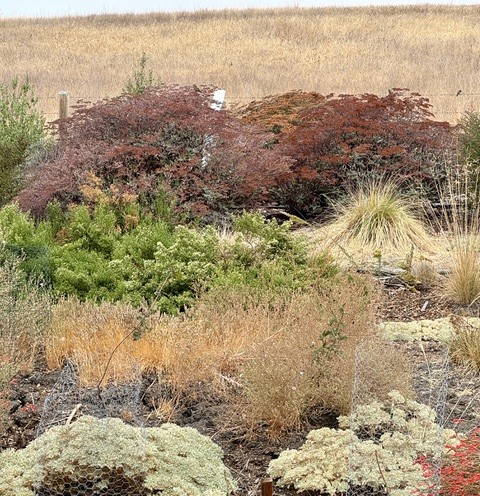
End of summer colors in Bill Milligan’s garden in Blackhawk
Sixth and finally, you need to plan for the “care gap”. With an ordinary irrigated garden, a landscaping company such as ours can install the plants, set the irrigation controller and walk away. Set and forget.
With a natural rain garden, it is important for someone, ideally with experience, to be watching the garden in the first year or two to make sure that young plants have a chance to establish themselves with deep root systems before they are expected to go it alone without irrigation. We can provide that service also.
Kate Coulson recommends hand watering (I would suggest with an oscillating sprinkler) once a month in the first summer. In my garden in Oakland, my own experience was that many plants, put in the ground by September, had established their root systems enough to survive the following summer without further watering. Plants put in the ground late in the rainy season needed much more careful attention. It also varies to a certain extent with aspect, the amount of sun or shade that plants receive, and with location.
To sum up, there is a lot of potential to build successful and beautiful gardens in the Bay Area without using irrigation. Using techniques developed by gardeners in dry climates around the world, using plants that grow in dry places from around the world, and by adapting our expectations of what a garden looks like and how it should be made, we can make gardens that are both interesting year-round and that in the end save money, time and resources. (Scroll down for more images).

Susan Boyle garden, Oakland, establishment phase

Susan Boyle garden, Oakland oxalis incarnata happy in dry shade

Susan Boyle garden, Oakland, carex divulsa in shade

Arrtemesia ‘canyon gray’, late summer, Bill Milligan, Blackhawk

Eleagnus ‘gilt edge’ in deep, dry shade, Julia Partridge, Oakland
